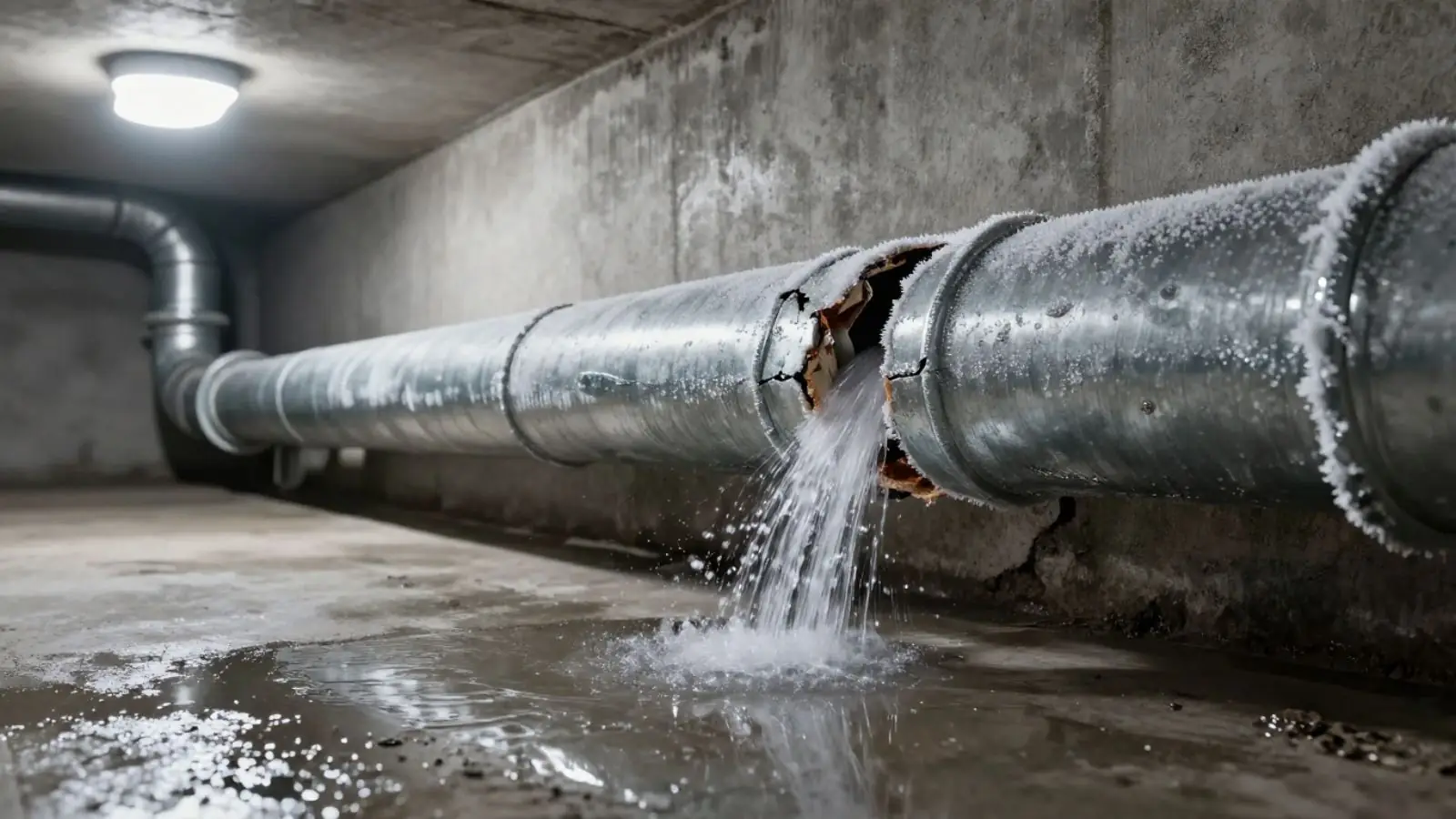
Frozen pipe water damage starts when water inside a supply line turns to ice and expands. The ice itself rarely floods anything. The split it leaves behind does, and the water usually shows up when the pipe warms and the ice plug lets go.
In Littleton, CO, that means a house can look fine through the coldest night and flood by mid-afternoon. If you are reading this with water running, shut off the main valve and call our 24/7 line.
Where pipes freeze in Littleton houses
The usual trouble spots are lines in exterior walls, runs through garages, pipes in crawl spaces and any room that gets no heat. A bathroom over a garage and a hose bib line that was never drained both fit that pattern. Frozen pipe bursts cluster in hard cold snaps, so our call volume is seasonal.
A pipe also freezes more easily when heat is turned down for a trip or the power goes out.
When a frozen pipe is an emergency
A pipe that is frozen but not yet burst is an urgent problem, though not yet a flood. A pipe that has split and is now thawing is a full emergency, because it can release water at household pressure into a wall or ceiling you cannot see. The longer it runs, the more drywall, insulation and flooring it reaches.
Call right away if you hear running water inside a wall, see water coming through a ceiling or find a wet floor under a cold room. Do not wait for the temperature to rise, since rising temperature is exactly what starts the flow.
| What you see | What it usually means | What to do |
|---|---|---|
| Faucet gives a trickle or nothing | Ice plug in the supply line | Open the tap, find the cold section, keep heat on it |
| Bulge or crack in a pipe | Split already formed | Shut off the main valve before it thaws |
| Hissing or dripping in a wall | Thawing split is leaking | Shut off the main valve and call |
Safety steps for the first hour
- Find the main shut-off valve. Denver Water notes that in most single-family homes it sits in the basement or crawl space, on a wall that faces the street.
- Switch off power to wet rooms at the breaker only if the panel is dry and you can reach it standing on a dry surface.
- Call our 24/7 line, then your insurer, and take photos before anything is moved.
If a pipe is frozen but not yet burst
Shut off the water first, then open the nearest tap so melting ice has somewhere to go. Warm the pipe slowly with a hair dryer, working from the faucet end toward the frozen section. Never use a torch or open flame, which can scorch framing and split the pipe faster.
How we dry a house after a thaw flood
Stop and map the water
We confirm the supply is off, then use moisture meters and a thermal camera to trace where the water traveled.
Extract standing water
Truck-mounted or portable extraction units pull water from floors, and weighted tools lift it from carpet.
Open what is wet
Wet insulation and the lower section of soaked drywall are cut out so the cavity can dry.
Dry with controlled airflow
Air movers and LGR dehumidifiers run until readings reach the target, usually after several days.
Pipe split or thawing right now? Call the 24/7 line and tell us what is wet.
Call (303) 952-8295What changes the cost of a frozen pipe loss
- How long the pipe ran before the water was shut off.
- Whether the water stayed in one room or traveled through walls and ceilings to floors below.
- How much drywall and insulation must be removed to reach wet framing.
- The number of days equipment runs before readings reach target.
We explain the scope and the price in plain terms before any work begins, so you can decide with the numbers in front of you. See emergency water removal and water mitigation for the details. We do not repair the pipe itself, and a plumber has to fix the split before we start drying.
Insurance and burst pipes
The Colorado Division of Insurance advises that burst pipes and the resulting water damage are generally covered under homeowners and renters policies. The insured must take steps to prevent further damage, which is why shutting off the water matters, but should get the insurer's instructions before repairs.
Gradual leaks and long-term neglect are treated differently from a sudden burst. Read your policy, ask your insurer about deadlines, and keep your photos.
Prevention and mistakes to avoid
- Do not leave a frozen pipe alone and hope it holds. Ice that melts under pressure is how floods start.
- Do not cover a wet wall before it is measured dry.
Littleton, CO: Denver Water, shut-off valves and cold seasons
Denver Water supplies Littleton residents, and its cold weather tips say a frozen indoor meter can flood a basement and that replacing it is at the homeowner's expense. Find your main valve and meter this week and tag the valve.
NWS Boulder lists Denver's normal seasonal snowfall at 49.0 inches at Central Park and says the western and southwestern suburbs average about 65 to 70 inches a season. Those are metro figures, not Littleton readings. Check crawl space vents and garage walls before the first freeze.
The Colorado Division of Insurance says to contact your insurer as soon as possible after a burst. Save the claim line in your phone before winter.
Sources: Denver Water cold weather tips, City of Littleton Utilities page, NWS Boulder seasonal snowfall pages, Colorado Division of Insurance consumer advisories.
Crews also cover Englewood and Morrison, where older homes with exterior-wall plumbing have the same thaw-day risk. After drying, any rebuild of opened walls moves to water damage repair. Industry guidance such as ANSI/IICRC S500 is the published reference for drying, and you can ask any company whether its crews work to it.
Common questions
Yes, the line works through the night in cold snaps, which is when frozen pipes tend to split. Crews go out as they become free, and no arrival time is promised. While you wait, the dispatcher helps you find the main valve and keep the thaw slow.
Ice can plug a split completely. While the pipe is frozen nothing escapes, and when it thaws the plug melts and water flows through the crack under full pressure.
No. A plumber repairs or replaces the pipe, and Littleton requires a permit for plumbing repair work. We extract, remove wet materials and dry the structure.
Denver Water says it is usually in the basement or crawl space on a wall facing the street. Find it before you need it and make sure it turns.