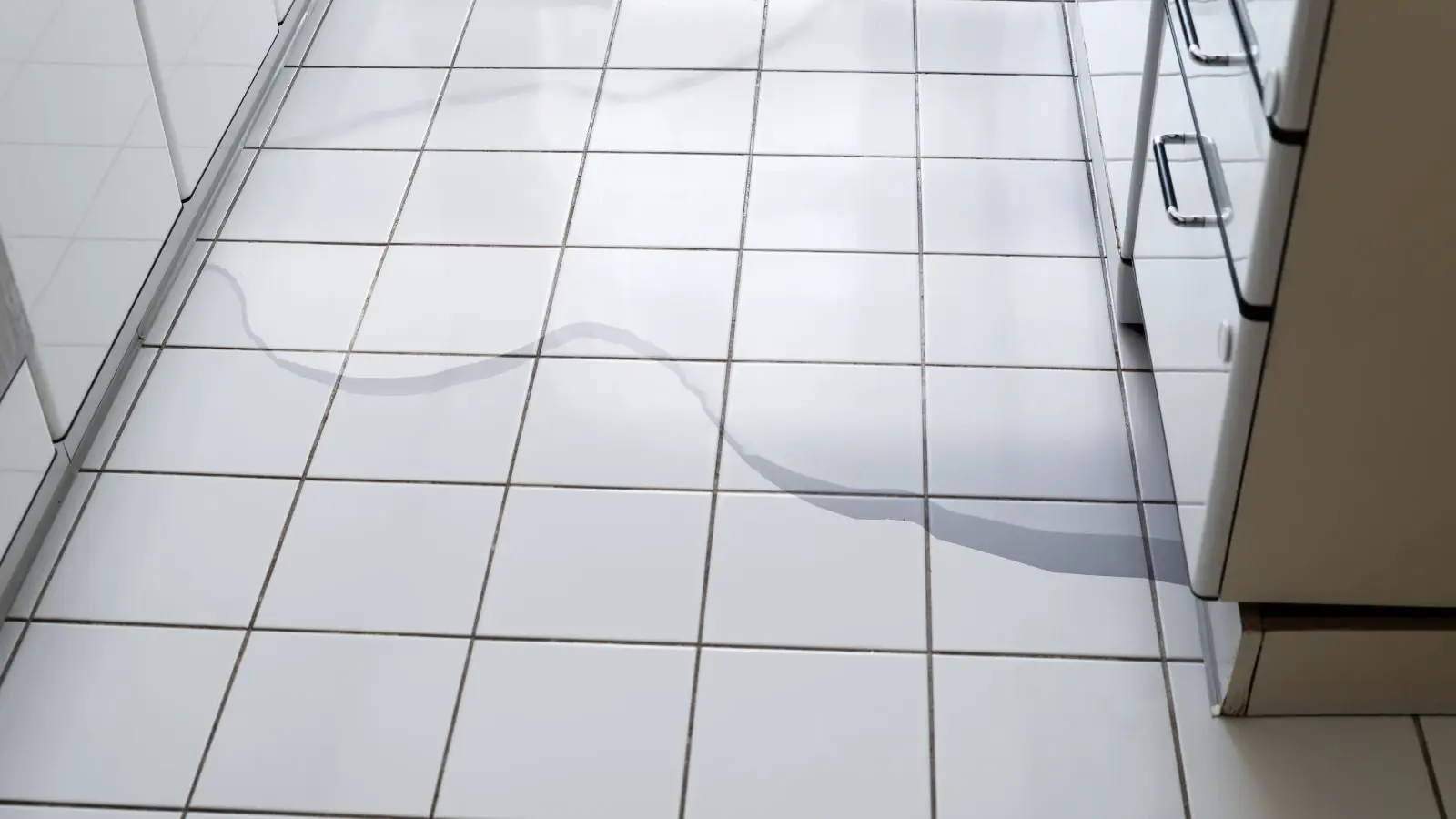
Kitchen water damage is what happens when a supply line, drain, appliance hose or faucet lets water out where cabinets, countertops and flooring sit stacked together. In Littleton, CO the usual story is a slow drip under the sink that nobody sees for weeks, or a dishwasher or ice-maker line that lets go while you are out.
A small leak can reach the toe kicks, the subfloor and the wall behind the range before you see a puddle.
Where the water comes from
The sink area causes most of the trouble. Braided supply lines, the P-trap, the disposal connection and the faucet base all sit inside a cabinet where a drip runs down the back panel and into the base.
Dishwashers leak at the door gasket, the inlet valve and the drain hose. Ice-maker lines are thin tubing that can crack behind the fridge, so water runs under the flooring edge without reaching the middle of the room.
What the damage tells you
| What you see | What it usually means | What happens next |
|---|---|---|
| Swollen, crumbling cabinet floor | Particleboard soaked from a long, slow leak | Cabinet box is often replaced, doors and frames may be saved |
| Cupped or lifting floor near the sink | Water spread under the flooring | Moisture mapping, then drying the subfloor or lifting boards |
| Musty smell with no visible puddle | Wet insulation or drywall behind cabinets | Remove the toe kick or a back panel and check the cavity |
| Brown ring on the ceiling | Leak from the bathroom above | Open the ceiling if soft, dry the joist bay |
First hour safety steps
Close the shut-off valve under the sink if the leak is at the faucet or a supply line. Each fixture has its own small valve, and turning it clockwise stops that line. If the valve will not move or the leak is at the main, close the home's main shut-off instead.
Kitchens are full of outlets and appliances. Unplug anything only if you can reach the cord while dry, and switch off the kitchen breaker if outlets are wet or the ceiling drips near a light.
Do not slide the dishwasher or fridge out yet
Pulling a heavy appliance across a wet floor can tear the water line. Shut off the water to that appliance first and let us look at the floor behind it.
How we dry a wet kitchen
Stop and extract
We confirm the source is shut off, then pull standing water from the floor and cabinet bases with extraction units.
Map the moisture
Moisture meters and a thermal camera show which cabinets, wall sections and floor areas are wet beyond what you can see.
Open the hidden spaces
We take off toe kicks and drill small holes at the cabinet base so air can reach the wet cavity.
Dry with equipment
Air movers push air through the cabinet boxes and under the floor while LGR dehumidifiers pull moisture out of the room.
Monitor and clean
We recheck readings daily, clean and treat surfaces, and tell you which materials need replacing.
Injection drying forces warm air into a cabinet base through small ports, and removing the toe kick lets air sweep the cavity. Solid wood boxes usually dry and stay. Swollen particleboard stays swollen, so it is replaced.
Water behind the cabinets? Call and tell us which fixture leaked and how long it ran.
Call (303) 952-8295Save or replace: what holds up
Solid wood and plywood cabinets handle a short wetting well. Laminate-wrapped particleboard does not, because the core swells and the surface lifts at the edges. Stone counters are not harmed by water, but the cabinet base and seam beneath them can be.
Tile survives, though backer board and grout can hold moisture. Vinyl plank and laminate often come up so the subfloor can dry. Hardwood may cup and then relax, so we watch the readings before anyone sands or replaces it.
Our job ends where the dry, clean room begins. The rebuild of cabinets, counters and flooring is covered under water damage repair, and a leak that began in an appliance has its own notes on appliance leak damage.
What changes the cost
- How many cabinet runs and how much floor area got wet.
- Whether the water was clean supply water or came from a drain.
- How long the leak ran before anyone found it.
- Flooring type, since tile, hardwood and vinyl dry differently.
- How much must be opened up to reach wet insulation or framing.
We walk through the scope with you and state the price before any work starts. Insurance for this kind of loss usually turns on sudden versus gradual. A failed hose or burst line is often covered, while a drip that ran for months often is not, so ask your insurer.
Mistakes to avoid in a wet kitchen
- Leaving the toe kicks on and hoping the cabinet dries by itself.
- Running the dishwasher or disposal while a drain connection is suspect.
- Sealing a counter seam or laying flooring before the readings are dry.
- Wiping the surface while the subfloor stays wet underneath.
Littleton, CO: permits, insurance and older kitchens
The City of Littleton Permit Center requires a permit to install, alter, repair or replace any plumbing system. If the leak means a new supply line or drain run, ask your plumber whether a permit applies before the wall is closed.
The city also requires a contractor license or registration to pull permits, plus proof of liability insurance. Ask whoever rebuilds your cabinets which Littleton license applies when permits are involved.
Colorado Division of Insurance advisories say the insured should prevent further damage but get the insurer's instructions before repairs. Take photos and let drying start, then ask before you discard cabinets.
Littleton has designated historic districts, and older buildings often have original wood floors and older plumbing. In an older kitchen, have the flooring under the cabinets checked and the supply lines looked at.
Sources: Littleton Permit Center page, Colorado DORA consumer page, Colorado Division of Insurance advisories, City of Littleton historic districts.
We also dispatch for kitchen leaks near Lone Tree and Aurora.
Common questions
Yes. A leak under the sink or behind the dishwasher can be called in at any hour. We send a crew when one is available and promise no arrival time. Until then the dispatcher explains how to use the shut-off valves under the cabinet.
Solid wood and plywood often can. Swollen particleboard usually cannot. We check each box with a meter before telling you which way it goes.
Most kitchens need several days with equipment running. Thick subfloors and cabinet bases take longer than open floor, and we only stop when the readings reach dry targets.
No. Plumbing repair belongs to a plumber. We dry the damage and can plan around your plumber so the shut-off and the drying happen in the right order.
The ceiling, insulation and joist bay get wet along with the cabinets below, so we dry both levels and check light fixtures for water.