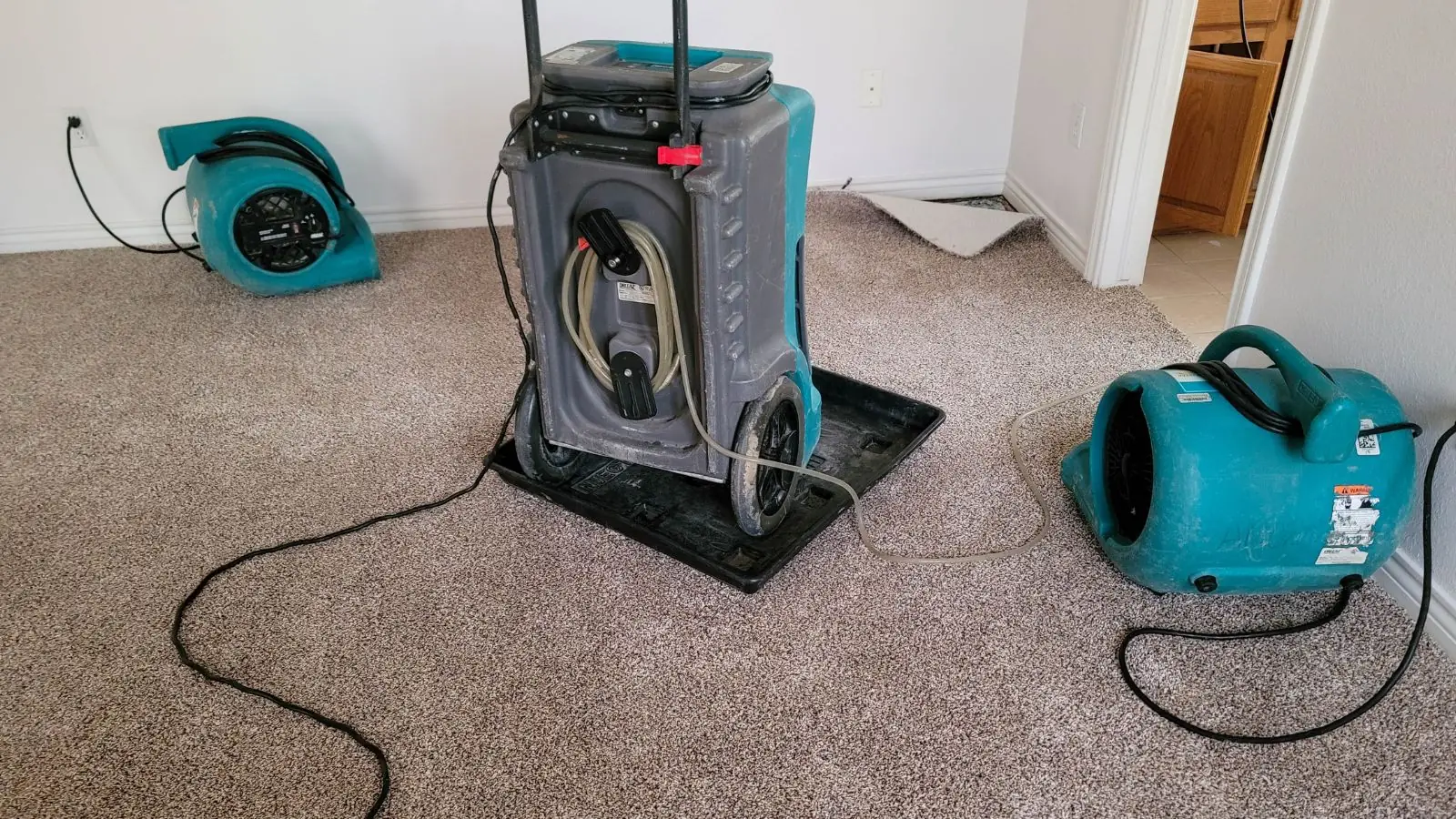
Structural drying removes moisture that soaked into the building itself: studs, plates, subfloors, concrete, plaster and the air in the room. In Littleton, CO, that matters after burst pipes, appliance leaks and storm water, because the surface may look fine while the framing behind it holds water.
This page covers the method and the monitoring. The first-response work of stopping the loss and removing soaked materials sits on the water mitigation page.
Moisture content versus relative humidity
Two different measurements run through every drying job. Moisture content tells you how much water is in a material such as a stud or a floor. Relative humidity tells you how much water vapor the air holds compared with the most it could hold.
Drying works by moving water from material to air, then removing it from the air. A room with air at a normal humidity can still have wet framing, so both numbers are tracked.
Why Colorado's dry air does not dry your walls
The NWS puts Denver's normal annual precipitation at 14.48 inches, and the Front Range air is often dry. That helps surfaces dry out, but it does not pull water out of a closed wall cavity or a subfloor under flooring.
Water trapped in a sealed space dries slowly and can sit long enough to feed mold. Opening the cavity, moving air through it and removing the moisture with equipment is what finishes the job.
| Tool | What it does | Where it fits |
|---|---|---|
| LGR dehumidifier | Removes vapor at lower humidity levels | Most rooms after a clean water loss |
| Desiccant dehumidifier | Uses a drying wheel to pull vapor in cooler or very dry conditions | Cold spaces or deep, stubborn moisture |
| Air mover | Moves air across wet surfaces to lift moisture | Floors, lower walls, ceilings |
| Drying mat or injection system | Pulls air through a floor or into a wall cavity | Hardwood, subfloors, closed walls |
| Moisture meter and thermal camera | Finds and tracks wet materials | Every visit |
How we set up and monitor the drying
Map the wet area
Meters and a thermal camera show where the moisture traveled, and readings are logged on a sketch.
Set drying goals
A dry standard is set from unaffected materials in the same house, so the target is real, not a guess.
Place equipment
Air movers are positioned to push air along surfaces, and dehumidifiers are sized to the volume of the space.
Contain the area
Doors and vents are closed or sealed so the equipment works on the wet space only.
Check every day
We return, re-read the same points and adjust equipment until each reading reaches target.
Drying typically takes several days. Dense materials such as concrete and hardwood dry slowest.
Water is out but the house still feels damp? Call and we will explain how drying is measured.
Call (303) 952-8295Why it feels dry is not dry
Your hand cannot tell the difference between a dry surface and a wall that still holds water inside. Paint, flooring and trim can mask moisture for weeks. Mold can begin to grow within 24 to 48 hours in wet organic material, so a surface that looks fine is not proof of safety.
The reading is the proof. When we stop equipment, it is because meters show the material at or below the dry standard, and not because the room seems comfortable.
Safety steps while equipment is running
- Keep cords and hoses clear of walkways, and do not unplug dehumidifiers to use the outlet.
- Keep children and pets away from running equipment and from open wall cavities.
- Leave doors and containment as they are so the air stays where it is needed.
- Call us if a machine stops, if you smell burning, or if a reading looks wrong to you.
What changes the cost of structural drying
- The number and type of materials that are wet, such as concrete, hardwood or framing.
- Square footage and ceiling height of the affected space.
- How many days the equipment needs to run and how many pieces are needed.
- Whether walls or floors must be opened for access or injection.
- Containment needs, for example when the water was not clean.
We explain the plan and the price before work starts, and the daily log supports your insurer's file. Sudden and accidental water losses are often covered, while gradual leaks often are not, so check your policy.
Mistakes to avoid while drying
Do not turn the heat up to dry things faster, since heat alone just raises the humidity. Do not close the wet room off from a running dehumidifier, and do not paint or refloor until the numbers are final.
Rebuilding too soon traps the water
New drywall, flooring and paint over a damp cavity can cup, stain or grow mold. Ask for the final readings before any rebuild starts.
Littleton, CO: climate and housing
Denver's 1991 to 2020 normal annual precipitation is 14.48 inches at Central Park, according to NWS Boulder. Dry outdoor air is a helpful partner, but sealed cavities do not benefit from it, so we open or inject them instead of waiting.
Older buildings in the city's historic districts often keep original wood floors and plaster. Tell us the age and the finish when you call, so we choose the right drying method for them.
The Colorado Division of Insurance says the insured must take steps to prevent further damage but should get the insurer's instructions before repairs. Our daily moisture log shows what was done and when, which gives your claim file a clear record.
Sources: NWS Boulder annual summary, City of Littleton historic district information.
We dispatch to Lone Tree and Aurora as well. Once the readings are final, the next step is water damage repair, and if you saw growth, see mold remediation. Drying follows ANSI/IICRC S500, the published standard for water damage restoration, and you can ask any company if its crews work to it.
Common questions
Drying itself runs on a schedule of visits, but the line is open all hours if equipment stops, a room is still wet or something new appears. We dispatch when a crew is available and do not promise an arrival time.
Several days is typical. Concrete, hardwood and thick framing take longer than drywall, and the readings, not the calendar, tell us when to stop.
They help on small, clean losses. Larger spills need meters and sized equipment, because household units rarely remove enough vapor to reach target.
No. We run the equipment ourselves and monitor it, so the settings change as the readings change.
Often, if the smell comes from damp materials. If growth has started, the area may need mold remediation after it is dry.