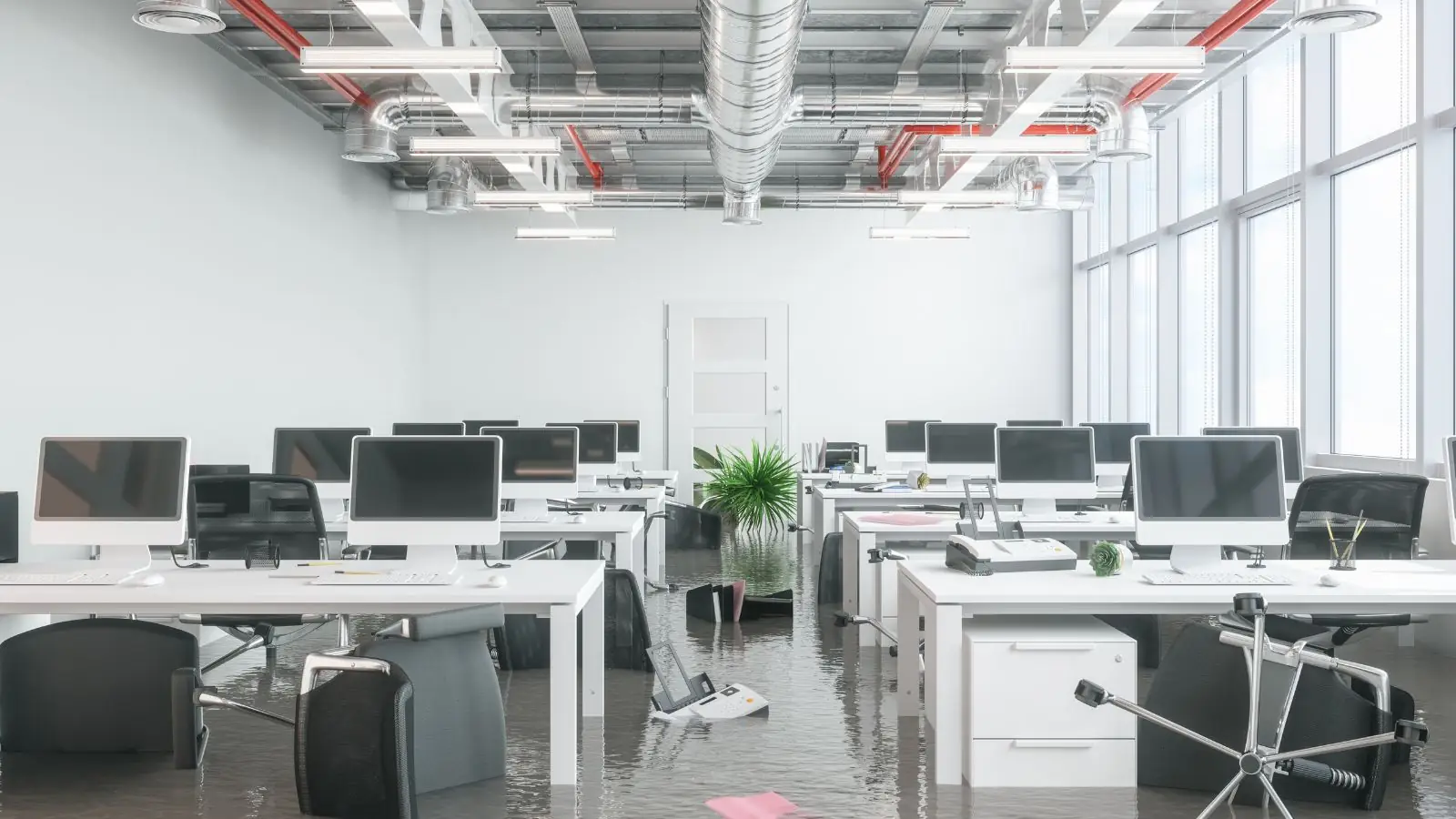
Commercial water damage restoration covers losses in office, retail and shared-use buildings in Littleton, CO. The core work matches a home loss: stop the spread, extract water, remove what cannot be saved and dry the structure. The differences are scale, access and paperwork.
A broken supply line over a ceiling can wet several rooms, and a sprinkler or fixture failure can reach neighboring units. This page lays out what we can do and what the property owner or manager still has to handle.
How a commercial loss differs from a home
- Footprints are larger, with more rooms and long runs of flooring.
- Ceiling tiles and grid systems absorb water and sag, then drop.
- Commercial carpet is often glued down over a concrete slab.
- Concrete slab floors hold moisture longer than wood framing.
- Shared walls and units mean water can move into spaces you do not control.
- Keys, alarms and building access must be arranged before crews can start.
Safety steps in the first hour
- Find and close the water shut-off for the affected line or the building main, if you can reach it safely.
- Keep people out of wet areas. Slippery floors and sagging ceiling tiles are hazards.
- Do not touch outlets, panels or equipment that are wet. Have the building electrician or utility make them safe.
- Contact the building manager or owner, and the utility if the source is outside your control.
- Photograph the damage and the source before anything is moved.
- Call our 24/7 line with the address, the source and who can give us access.
| What you see | What it usually means | What we do |
|---|---|---|
| Stained or sagging ceiling tiles | Water above the grid | Remove wet tiles, dry the plenum space |
| Carpet squishes underfoot | Saturated pad over slab | Extract, lift, dry or remove |
| Baseboard or wall bubbling | Water inside the wall | Meter and open to dry |
| Water at the neighboring unit's wall | Spread through a shared wall | Map the wet area and coordinate access |
| Musty odor days later | Hidden moisture remains | Thermal and meter survey, extend drying |
Our process on a commercial water loss
After-hours dispatch
The 24/7 line takes the call, and we dispatch a crew when one is available.
Walk the site and document
We photograph the damage and take moisture readings so the owner and the insurer have a clear record.
Extract the water
Truck-mounted and portable extraction units remove standing water from carpet, tile and slab.
Move contents where practical
Light items are moved and protected so flooring can be worked on.
Dry the structure
Air movers and LGR or desiccant dehumidifiers run, with daily moisture readings, as described on structural drying.
Phase around occupied space
We plan equipment placement and work areas so the rest of the building can keep functioning when it is safe to do so.
Water in a commercial building? Call the 24/7 line and give us the address and the source.
Call (303) 952-8295What the property owner or manager still handles
We do not communicate with tenants or customers for you. Notices, schedules and temporary relocation are the owner's or manager's job. We can tell you which areas are affected and for how long, in plain terms, so you can plan.
Building management also coordinates the utilities, fire alarm and sprinkler systems, and any landlord approvals. We do not repair plumbing, roofs or building systems, so a plumber or roofer handles those.
What changes the cost of a commercial loss
- Total area wet and the number of rooms or units reached.
- Flooring type, such as glued carpet, tile or sealed concrete.
- Ceiling and wall materials that must be removed.
- Days of drying and the number of machines needed.
- Access limits, such as after-hours entry or restricted areas.
- Water type, since contaminated water adds containment.
We explain what the job involves and what it costs before work starts, and we separate emergency steps from later repair items.
Insurance and documentation
Commercial property policies vary widely, so read yours rather than assume. Sudden and accidental water losses are often covered, while gradual leaks and flood often are not. Business interruption, if you carry it, is a separate part of a policy, and your agent can explain how it applies.
The Colorado Division of Insurance advises starting a claim as soon as possible, taking steps to prevent further damage and getting your insurer's instructions before repairs. We provide photos, moisture logs and a written scope that you can pass to your insurer.
Photograph first, then dry
Take wide and close photos of the source, the wet materials and the contents before anything is moved. It makes your insurance file easier to support.
Mistakes to avoid after a commercial water loss
- Waiting until Monday because it happened on a weekend.
- Leaving wet ceiling tiles and carpet in place to see if they dry.
- Letting repairs start before the structure has dried.
Littleton, CO: permits and contractors
The City of Littleton Permit Center in the Littleton Center, on Berry Avenue, requires permits for work on electrical, gas, mechanical or plumbing systems. A building owner whose rebuild reaches those systems should call 303-795-3751 before anyone starts.
The city requires a contractor license or registration certificate to pull permits, and it requires proof of liability insurance. Ask each contractor on your repair for its Littleton license and proof of insurance, since Colorado DORA notes that not every occupation, including general contractors, is licensed at the state level.
Sources: Littleton Permit Center page, Colorado DORA consumer page, City of Littleton contractor licensing.
We also dispatch to Englewood and southwest Denver for commercial calls. The first steps of a loss follow water mitigation, and a burst line that floods a floor may call for emergency water removal. Our work follows ANSI/IICRC S500 as the published standard.
Common questions
Calls are taken at any hour, including nights and weekends, and we dispatch when a crew is available. We do not commit to a set arrival time, but the dispatcher can talk a manager through shutting off water and protecting equipment first.
Yes. The 24/7 line takes after-hours calls. Tell us about access, keys and alarms so crews can enter.
No. Communication with tenants and customers is the owner's or manager's job. We tell you which areas are affected and for how long.
Often yes, when it is safe. We plan containment and equipment placement around occupied areas and tell you what to expect.
No. A plumber or roofer handles the source. We handle the water, the drying and the documentation.
Someone with authority to approve work and arrange access, such as the owner or building manager. Tell us in the first call who that is.